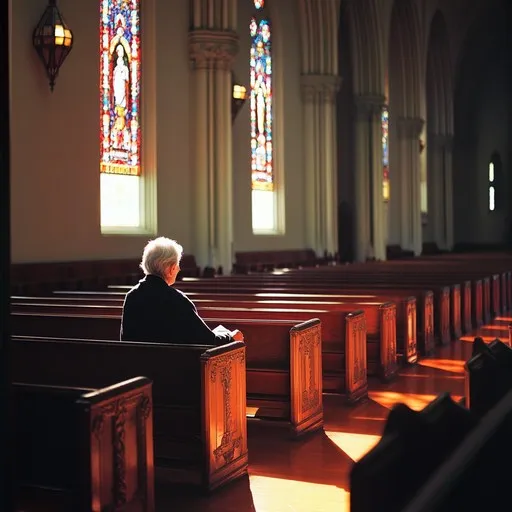
Open Hands, Open Heavens: Why Releasing Control Is the Deepest Form of Trust

Photo: IMedscaper, CC BY-SA 4.0, via Wikimedia Commons
There is a particular kind of anguish that does not announce itself loudly. It does not arrive with catastrophe or sudden grief. It settles in quietly — in the sleepless hours spent recalculating, in the prayers that sound more like negotiations, in the way we hold our breath waiting for life to finally align with the plan we have drawn so carefully in our minds. It is the suffering of the clenched fist: the soul that has mistaken control for faithfulness.
And yet, if the Scriptures speak with any consistent clarity on this matter, it is this: the men and women through whom God worked most profoundly were almost always the ones who had to abandon their own blueprints before they could participate in His.
The Illusion We Call a Plan
American culture has a complicated relationship with ambition. From an early age, we are taught to set goals, map trajectories, and measure our worth against the milestones we reach on schedule. There is nothing inherently wrong with diligence or forethought — Proverbs commends the one who plans wisely. But there is a subtle idolatry that can take root even in the most earnest of hearts: the belief that our timeline is the measure of God's faithfulness.
When the career stalls, when the relationship does not materialize at the expected moment, when a medical diagnosis rewrites the next five years without our consent — something in us experiences this not merely as disappointment, but as divine failure. We had a plan. God, it seems, did not honor it.
This is the spiritual tension that so many believers carry in silence. To release the plan feels like releasing hope itself. And so we hold on, white-knuckled, as though our grip is what keeps the promise alive.
Joseph's Abandoned Blueprint
Consider Joseph, the son of Jacob, whose story unfolds across nearly fourteen chapters of Genesis with a kind of slow, painful deliberateness. Here was a young man with a vision — literally. God had shown him, in dreams, a future of significance and influence. One might reasonably expect that such a divine revelation would be accompanied by a smooth and dignified path toward its fulfillment.
Instead, Joseph was stripped of his coat, thrown into a pit, sold into slavery, falsely accused, and imprisoned. At virtually every juncture, the timeline he might have imagined for himself was not merely delayed — it was demolished.
What is remarkable is not simply that God eventually restored Joseph, but that Joseph could not have arrived at the place of his purpose by any other road. The years in Potiphar's house, the seasons in the dungeon, the encounter with Pharaoh's cupbearer — each chapter that looked like abandonment was, in truth, a careful preparation. Joseph had to lose every version of his plan before he could inhabit God's.
Surrender, in Joseph's story, was not passive resignation. It was the active, costly, daily choice to remain faithful within circumstances he had not chosen and could not control.
The Grief That Accompanies Letting Go
It would be dishonest — and pastorally irresponsible — to speak of surrender as though it were painless. Releasing a timeline to which we have attached our identity, our hope, or our sense of God's goodness is a genuine form of grief. The couple who releases the dream of biological children, the professional who relinquishes a career path after years of faithful effort, the person who surrenders the hope of restored health — these are not small losses dressed up in spiritual language.
The Psalms understand this. They are filled with lament, with the raw vocabulary of a soul that has not yet reconciled what it hoped for with what it has received. Psalm 13 opens with four consecutive questions of anguished abandonment: How long, O Lord? Will you forget me forever? The psalmist does not perform peace he does not feel. He brings his unresolved grief directly to the throne.
This is, perhaps, the first movement of genuine surrender: not the suppression of sorrow, but the honest presentation of it to God. We do not release our timelines by pretending they did not matter. We release them by trusting that the One to whom we offer them is worthy of what the offering costs us.
When Waiting Becomes Formation
There is a word that appears throughout the Old Testament with a frequency that modern readers often underestimate: the word wait. The prophet Isaiah declared that those who wait upon the Lord would renew their strength. The Hebrew word used — qavah — carries the image of a cord being twisted and strengthened under tension. Waiting, in the biblical imagination, is not passive inactivity. It is a process of being made stronger through the very pressure of unresolved hope.
This reframes the seasons of uncertainty that so many believers experience. The period between the promise and the fulfillment — between the diagnosis and the healing, between the prayer and the answer — is not wasted time. It is formative time. It is the season in which character is deepened, dependence is cultivated, and the soul is slowly shaped into something capable of carrying what God intends to place within it.
Abraham waited twenty-five years between the initial promise of a son and the birth of Isaac. Moses spent forty years in the wilderness before he stood before Pharaoh. The disciples waited in the upper room, bewildered and grieving, before the Spirit descended at Pentecost. In each case, the waiting was not a detour from the story — it was an essential chapter within it.
Surrender as a Spiritual Practice
For those navigating their own seasons of uncertainty, surrender is less a single dramatic moment than a daily discipline. It is the quiet choice, repeated morning by morning, to open the hand that closed overnight. It is the prayer that asks not merely for the desired outcome, but for the grace to trust the Giver more than the gift.
Practically, this might look like releasing a specific deadline — the age by which something must happen, the year by which circumstances must change — and replacing it with a posture of attentive expectation. It might mean confessing to a trusted fellow believer the fear that underlies the need for control, and receiving in return the reminder that God's faithfulness is not contingent on our management of outcomes.
It might, most profoundly, look like the prayer of Gethsemane — the one that contains both honest desire and ultimate deference: Not my will, but Yours be done.
The Paradox at the Heart of Grace
Grace, by its very nature, resists our attempts to earn or engineer it. It arrives not as the reward for our careful planning, but as the gift of a God who operates according to a wisdom that consistently exceeds our own. The great paradox of the surrendered life is that the open hand receives far more than the clenched fist could ever hold.
This does not mean that every surrendered prayer results in the outcome we would have chosen. Sometimes God's better plan looks nothing like what we imagined, and the acceptance of that reality requires its own particular courage. But the testimony of Scripture — and of countless lives transformed by grace — is that what God builds in the space our released plans leave behind is invariably more enduring, more life-giving, and more gloriously unexpected than anything we could have constructed on our own.
The invitation, then, is not to stop hoping. It is to hope more wisely — with hands open, eyes lifted, and hearts anchored in the unshakeable conviction that the God who holds our days is not indifferent to our longings, but is working, even now, toward ends that our limited vision cannot yet perceive.
Open your hands. The heavens are not closed.