Faithful in the Silence: The Sacred Discipline of Trusting God When Nothing Changes
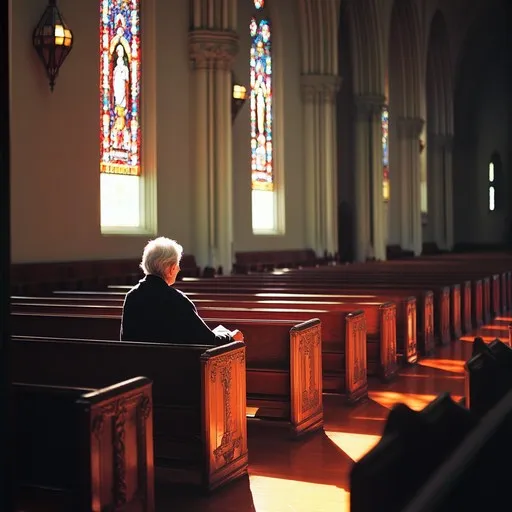
Photo: person praying alone in quiet church pew morning light, via images.stockcake.com
American Christianity has a complicated relationship with waiting.
We are a culture that prizes momentum, measurable outcomes, and the satisfying arc of a story that moves from crisis to resolution in a reasonable amount of time. We celebrate the testimony of the person who prayed, trusted, and received. We fill conference stages with voices that can point to the moment everything turned around. And there is genuine beauty in those stories — they are real, they are worthy of celebration, and they reflect the goodness of a God who does indeed act on behalf of His people.
But there is another story. It is told more quietly, often in the back pews and the private journals and the late-night prayers of people who have been faithful for years — sometimes decades — without the breakthrough they were promised seemed imminent. These are the people who have not stopped believing, have not abandoned their obedience, and have not grown bitter, even as the silence has stretched long enough to feel like an answer of its own.
This story deserves to be told with equal care. Because it may be the more common one. And it carries a form of grace that is easy to miss if we are only watching for visible results.
The Theology We Build Around Outcomes
Without always meaning to, many of us have constructed a quiet theology in which grace is measured by what it produces. We pray, and we watch. We obey, and we wait for confirmation. When the confirmation comes — the job offer, the restored relationship, the medical report — we point to it as evidence that God was present and active. When it does not come, we are left with a disorienting silence that our theology has not adequately prepared us to interpret.
This is not entirely our fault. The prosperity-adjacent messages that have saturated much of American Christian culture for decades have conditioned entire congregations to read visible outcomes as spiritual scorecards. Breakthrough becomes the metric of faithfulness. Blessing becomes the proof of obedience.
But this framework collapses under the weight of Scripture — and under the weight of honest human experience.
The Witnesses Who Waited
Hebrews chapter eleven is often called the "Hall of Faith" — a catalog of men and women whose trust in God produced remarkable acts of obedience. Abel, Abraham, Moses, Rahab. The chapter builds with momentum, and the reader is carried along by the cumulative power of these lives.
And then the chapter turns.
"Others were tortured, refusing to accept release, so that they might rise again to a better life. Some faced jeers and flogging, and even chains and imprisonment. They were put to death by stoning; they were sawed in two..." (Hebrews 11:35-37).
These are not the failure cases tucked quietly at the end of the list. They are presented as equally exemplary. The same faith that parted seas and shut the mouths of lions is the faith that sustained people who received none of those deliverances — who died waiting, who obeyed without seeing the resolution, who trusted a promise they never lived to witness fulfilled.
The writer of Hebrews does not treat their stories as lesser. He holds them alongside the miracle stories as equally valid expressions of the same faith. The breakthrough is not what defines the faith. The faithfulness is.
What Obedience Looks Like Without a Reward Structure
There is a particular kind of spiritual maturity that only develops in prolonged seasons of unanswered prayer. It cannot be manufactured through a weekend retreat or accelerated through a Bible study series, however excellent. It is formed slowly, in the repetition of choosing trust on a Tuesday morning when nothing has changed since last Tuesday, and nothing is likely to change before next Tuesday either.
This is the obedience that has been stripped of its transactional quality.
In the early seasons of faith, most of us obey with at least some implicit expectation of return. We tithe and anticipate provision. We forgive and expect the relationship to heal. We pray and wait for the feeling of peace to confirm that the prayer was heard. None of this is entirely wrong — Scripture does speak of God's faithfulness to those who seek Him, and hope is not a sin.
But the deeper formation comes when we continue to obey after those expectations have been quietly surrendered. When we tithe because it is an act of worship, not a transaction. When we forgive because we have been forgiven, not because it will repair what was broken. When we pray because communion with God is its own sufficient answer, not merely the mechanism by which we obtain other answers.
This is not resignation. It is not the spiritual exhaustion of someone who has given up expecting anything from God. It is something altogether different — a settled confidence in the character of God that no longer requires the evidence of outcomes to remain intact.
The Grace Hidden in Faithfulness Itself
We often speak of grace as something God extends toward us in our weakness — and this is beautifully true. But there is another dimension of grace worth considering: the grace that is the faithfulness itself.
When a man has prayed for a wayward child every morning for fifteen years, and that child has not yet returned — the fifteen years of prayer is a grace-saturated act. It is not the waiting room before the grace arrives. It is the grace, expressed through the slow, costly, daily surrender of a parent who continues to trust the Father with what he cannot control.
When a woman has navigated a chronic illness with quiet dignity for a decade, continuing to serve her church and love her family and speak of God's goodness even as the healing she has requested has not come — her faithfulness in that season is not a lesser form of spiritual life. It is among the most profound.
God is not withholding His grace while she waits. He is expressing it through her capacity to remain.
Reframing the Definition of Victory
The culture around us — and too often the church culture within us — defines victory as the moment the circumstances shift. The addiction broken. The marriage saved. The diagnosis reversed. These are genuine causes for celebration, and we do not diminish them.
But if victory can only be located in the changed circumstance, then the person whose circumstances do not change is left without a testimony. And that is a theological failure we cannot afford.
Scripture offers a more durable definition. In Romans 8:37, Paul declares that believers are "more than conquerors" — and he writes this from prison, with full knowledge that his own circumstances are not resolved, that suffering is ongoing, and that the God he serves has not extracted him from difficulty. The victory he describes is not circumstantial. It is relational. It is the unbreakable connection between the believer and the God who holds them, regardless of what the surrounding conditions report.
Faithfulness in the silence is not the consolation prize for those who did not receive the miracle. It is, in its own right, a miracle — the quiet, sustained work of grace forming a soul that can hold steady when everything visible argues for despair.
A Word to Those Who Are Still Waiting
If you are in a long season of unanswered prayer — if you have been faithful and obedient and the breakthrough has not come — this word is for you.
Your faithfulness is not invisible. Your obedience is not wasted. The formation happening in you through this season is not a detour from God's purposes; it may be among the most central purposes He is working.
The silence is not absence. The waiting is not abandonment. And the story is not over.
Keep praying. Keep trusting. Keep showing up. Not because the outcome is guaranteed on your timeline, but because the God you are trusting is faithful — and because the life of faithful endurance you are living right now is itself a testimony to a watching world of what grace looks like when it has grown deep enough to hold steady in the dark.