Still Standing in the Messy Middle: How Daily Grace Carries You Between Who You Were and Who God Is Making You

Photo: person standing in morning light misty path forest spiritual journey hope, via images.stockcake.com
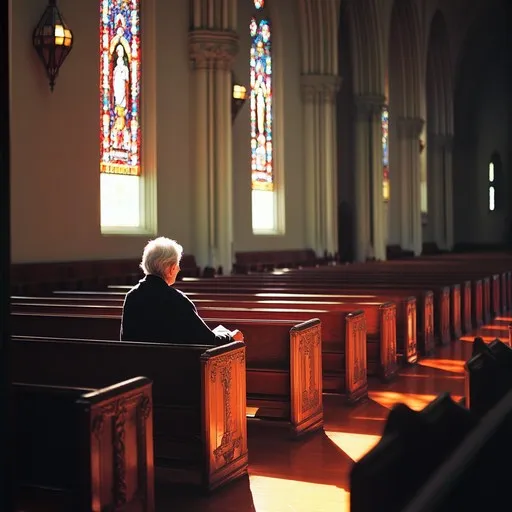
There is a particular kind of exhaustion that sets in when you have failed at the same thing more than once. Not the fatigue of a hard day's work, but the deep, soul-level weariness of someone who has prayed the same prayer, made the same resolution, and watched themselves stumble over the same threshold again. If you have ever sat in a church pew on a Sunday morning wondering whether the message of grace truly applies to someone with your particular record, you are not alone — and more importantly, you are not disqualified.
American Christianity has a complicated relationship with imperfection. We celebrate the dramatic testimony — the addiction conquered, the marriage restored, the prodigal returned — but we are far less comfortable with the person still in the process. The culture of spiritual performance runs deep, quietly insisting that genuine faith should produce visible, measurable progress at a pace others can admire. When growth is slow, when the same temptation resurfaces, when yesterday's resolve crumbles by Tuesday afternoon, many believers quietly conclude that something must be fundamentally wrong with them.
But Scripture tells a different story entirely.
Grace Is Not a One-Time Transaction
The Apostle Paul's letter to the Romans does not describe grace as a deposit made once and drawn upon indefinitely until the account runs dry. In Romans 5:2, Paul writes that through Christ "we have gained access by faith into this grace in which we now stand." The present tense is not incidental. We stand in grace — continuously, presently, right now — not merely in the memory of a grace once received.
This is a profound distinction. To stand in grace is to be perpetually upheld by something external to your own performance. It means that the ground beneath your feet does not shift when you fall, because the ground itself is not your faithfulness — it is God's. The gap between your worst day and your best self is not a void into which you tumble; it is the very space where grace does its most essential work.
Lamentations 3:22-23 captures this with remarkable plainness: "Because of the Lord's great love we are not consumed, for his compassions never fail. They are new every morning." Every morning. Not every spiritual breakthrough. Not every season of consistent devotion. Every single morning — including the ones that follow your worst nights.
The Perfectionism Trap and the American Christian
It would be difficult to overstate how profoundly the American cultural obsession with self-improvement has infiltrated the church. From productivity culture to personal branding, the underlying message is consistent: you are a project, and the project should be progressing. When that framework is imported into faith, grace quietly gets reframed as a starting block rather than a sustaining atmosphere. You receive it to begin the race, and then the expectation is that you run on your own merit from there.
The consequences of this distortion are spiritually devastating. Believers who struggle — and all believers struggle — begin to hide. They curate the version of themselves they present to their small groups. They answer "I'm doing well" when someone asks how their walk with God is going, because honesty feels too costly in an environment that prizes arrival over journey. The irony is staggering: communities built around a gospel of grace becoming the very places where grace feels least accessible.
Jesus reserved His most pointed rebukes not for the struggling and the broken, but for those who had mistaken their own spiritual tidiness for righteousness. The woman who lost a coin searched every corner of her house until she found it — she did not wait for the coin to present itself in a more convenient location (Luke 15:8-10). God's pursuit of the wayward, the weary, and the perpetually mid-stumble is not a reluctant concession. It is the posture of the Father running down the road before the prodigal son has finished composing his apology.
What the Messy Middle Actually Looks Like
Spiritual formation is rarely linear. The saints of church history knew this well. John Newton, who penned the words to Amazing Grace, continued to wrestle with his past long after his conversion. Charles Spurgeon preached to thousands while privately battling depression so severe it sometimes rendered him bedridden. The testimony of Scripture itself is populated not with polished paragons of virtue, but with men and women whose stories are marked by repeated failure, divine patience, and incremental, hard-won transformation.
Peter denied Christ three times — not once, not in a moment of dramatic crisis, but three times in the span of a single night. And yet the resurrected Lord's first recorded concern was to restore him specifically, personally, and tenderly (John 21:15-17). The question Jesus asked Peter was not "Have you learned your lesson?" It was simply, "Do you love me?" Grace does not demand that you have already become who you are meant to be. It asks only whether you are still oriented toward the One who is making you.
This is the sustaining truth for anyone living in the messy middle: orientation matters more than location. You do not have to be far along the path to be genuinely on it. You do not have to have conquered your greatest weakness to be legitimately growing. The direction of your heart — turned toward God, however haltingly, however imperfectly — is sufficient ground for grace to work.
Receiving Grace as a Daily Practice
If grace is not merely a historical event but a present reality, then receiving it must become a daily discipline rather than an occasional relief. This requires a deliberate resistance to the internal voice that insists you must earn your way back into God's good standing after every failure. That voice is not the voice of the Holy Spirit. Scripture is unambiguous: "There is now no condemnation for those who are in Christ Jesus" (Romans 8:1). Not "no condemnation after sufficient repentance." Not "no condemnation once the pattern has changed." No condemnation — full stop, present tense, unconditional.
Practically, this means beginning each day not with a performance review of the day before, but with a conscious return to the posture of the dependent child. It means confessing failure not as a groveling attempt to re-earn favor, but as a simple act of transparency with a Father who already knows and has already provided. It means allowing the Psalms to give language to the full range of your experience — the grief, the frustration, the honest admission that you are not where you thought you would be by now.
It also means extending to yourself the same grace you would readily offer another believer who came to you in their own broken honesty. The harshness with which many Christians speak to themselves in the privacy of their own minds would be recognized immediately as unkind if directed at another person. Grace is not the exclusive property of other people's struggles.
Your Worst Day Is Not Your Final Word
The beauty at the heart of the gospel is not that God tolerates your failures. It is that He has already written the end of the story, and your worst chapter is not the final one. The destination is not in jeopardy because the journey has been difficult. The inheritance does not diminish because the road to it has been longer and harder than you anticipated.
You are not defined by the gap between your failures and your calling. You are held, sustained, and being actively transformed within it. And the grace that meets you there — messy, unglamorous, and thoroughly undeserved — is the same grace that has been moving human hearts toward holiness since the foundation of the world.
Stand in it. Return to it daily. And trust that the God who began a good work in you is not finished yet.