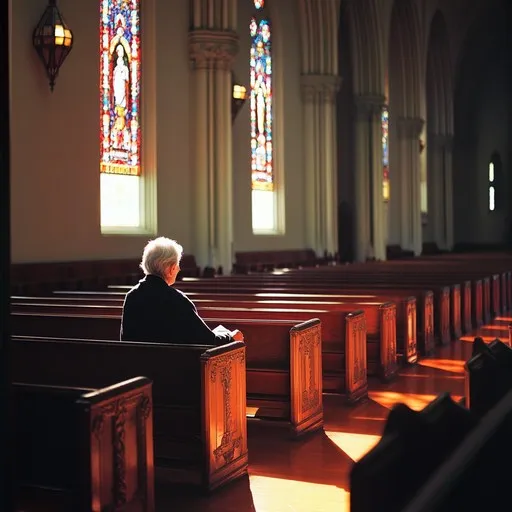
Soft Enough to Hear: How God's Quietest Moments Become Your Greatest Turning Points

Photo: PattayaPatrol, CC BY-SA 4.0, via Wikimedia Commons
There is a particular kind of spiritual restlessness that afflicts even the most devoted believers — a low-grade dissatisfaction born not from doubt, but from waiting. Waiting for the moment everything becomes unmistakably clear. Waiting for the sign so large it cannot be questioned, the intervention so dramatic it leaves no room for interpretation. We have been shaped, in part, by the grandest stories of Scripture: seas splitting, fire falling from heaven, the dead walking out of tombs. And so we wait, eyes fixed on the horizon, scanning for thunder.
Meanwhile, God is already speaking.
He is speaking in the conversation you almost dismissed. In the sentence from a book that seemed to reach off the page and press itself against your chest. In the unexpected pause during your morning commute when, for reasons you cannot explain, you felt something settle in your spirit. We are, many of us, so conditioned to anticipate the extraordinary that we have become functionally deaf to the sacred ordinary — and that deafness carries a cost far greater than we typically acknowledge.
The Precedent Set at Horeb
The story of the prophet Elijah in 1 Kings 19 is one of the most psychologically honest passages in all of Scripture. Here is a man who had just witnessed one of the most spectacular divine demonstrations in Israel's history — fire consuming a waterlogged altar, four hundred and fifty prophets of Baal utterly silenced. And yet, days later, Elijah is hiding in a cave, depleted and afraid, convinced he is the last faithful man alive.
God's response to this broken prophet is instructive. He does not send another fire. He does not repeat the thunder. Instead, He sends wind strong enough to shatter rocks, then an earthquake, then flame — and the text is deliberate in its clarification: the Lord was not in any of these things. What follows is a "still small voice," rendered in some translations as "a sound of sheer silence" or "a gentle whisper."
Elijah, who had just survived the spectacular, was reached by the quiet.
This is not incidental. It is a theological statement about how God chooses, far more often than we credit, to move. The dramatic moments in Scripture are real, but they are not the norm. The norm is the whisper. The norm is the gentle, persistent presence that does not compete with the noise of your life but waits — patiently, lovingly — for you to grow still enough to perceive it.
What We Forfeit in the Waiting for Thunder
Consider what Elijah might have missed had he remained fixated on the wind, the earthquake, and the fire. Had he decided that God's silence after those spectacles meant God's absence, he would have walked away from the very moment of his recommissioning. He would have missed the voice that restored his purpose, reoriented his grief, and sent him back into the world with renewed clarity.
This is the quiet tragedy of grace-deafness. It is not that God stops speaking. It is that we establish terms for how He must speak, and when He declines to meet those terms, we interpret His gentleness as distance.
Many Americans who have walked away from faith — or who have stalled in spiritual stagnation — will describe the same experience when pressed: they were waiting for a moment of certainty that never came in the form they expected. They prayed for a sign and received, instead, a nudge. They asked for a revelation and were given a restlessness. They sought the earthquake and overlooked the whisper that followed.
Grace is not always loud. In fact, the most redemptive grace — the kind that rewires the interior life rather than simply adjusting the external circumstances — tends to arrive softly, almost apologetically, as though it understands it is interrupting something.
The Anatomy of a Gentle Interruption
What does it actually look like when God whispers? It rarely announces itself. It tends to feel, at first, like coincidence — a chance encounter with a stranger who says precisely the thing you needed to hear, though they could not have known you needed it. It feels like a passage of Scripture that you have read a dozen times suddenly carrying a meaning it never held before. It feels like an unexpected kindness extended to you at the precise moment your cynicism was hardening into permanence.
These moments share a common quality: they are easy to explain away. And that, perhaps, is part of their design. They require something of us. They require attentiveness, humility, and a willingness to take seriously the possibility that the Creator of the universe is interested in the granular details of your ordinary Tuesday afternoon.
Spiritual maturity, in this sense, is not measured solely by theological knowledge or years of faithful service. It is measured, in significant part, by the capacity to recognize grace in its quietest forms — to develop what might be called a sensitivity to the sacred undertow, the gentle current pulling beneath the surface of your daily life.
Cultivating the Ears to Hear
Jesus closed numerous teachings with the phrase, "He who has ears to hear, let him hear." It is a curious statement when you consider that He was addressing people who were physically capable of hearing. The ears He referenced were something else entirely — a cultivated interior attentiveness, a practiced willingness to receive what is being offered rather than demanding it be delivered on your own terms.
Developing those ears requires, first and foremost, the discipline of stillness. In a culture that monetizes distraction and rewards constant productivity, stillness is a countercultural act. It is also a spiritual necessity. You cannot hear a whisper over the noise of a life lived at full volume. The Psalmist's famous instruction — "Be still, and know that I am God" — is not merely a comfort. It is a method.
It also requires a revision of expectations. If you have decided, consciously or otherwise, that God's meaningful communication will always feel seismic, you will perpetually undervalue what He is actually offering. The gentle prompting you keep dismissing as your own imagination may well be the very voice you have been asking Him to speak with. The recurring impression you have set aside as sentimental may carry more divine weight than you have been willing to assign it.
The Grace You Almost Walked Past
There is a grace that does not announce its arrival. It does not demand recognition or insist upon its own significance. It simply appears — in the unexpected phone call, the inexplicable peace that settles over a moment of crisis, the small mercy that arrives without fanfare and departs without applause.
This grace is no less powerful for its quietness. In many cases, it is more powerful, because it reaches the places within us that spectacle cannot access. The deepest wounds are not healed by fire. They are healed by the patient, persistent, unhurried presence of a God who is willing to whisper for as long as it takes until we are finally quiet enough to hear.
The question worth sitting with — genuinely, honestly, without the pressure of a tidy answer — is this: What might you be missing because you are still waiting for the thunder?
God's gentlest interruptions are not lesser interventions. They are, often, the most sacred ones. And the life transformed by a whisper is no less a testament to His glory than the one transformed by flame. It is simply a testament told in a quieter register — one that requires, and ultimately produces, a soul attentive enough to receive it.